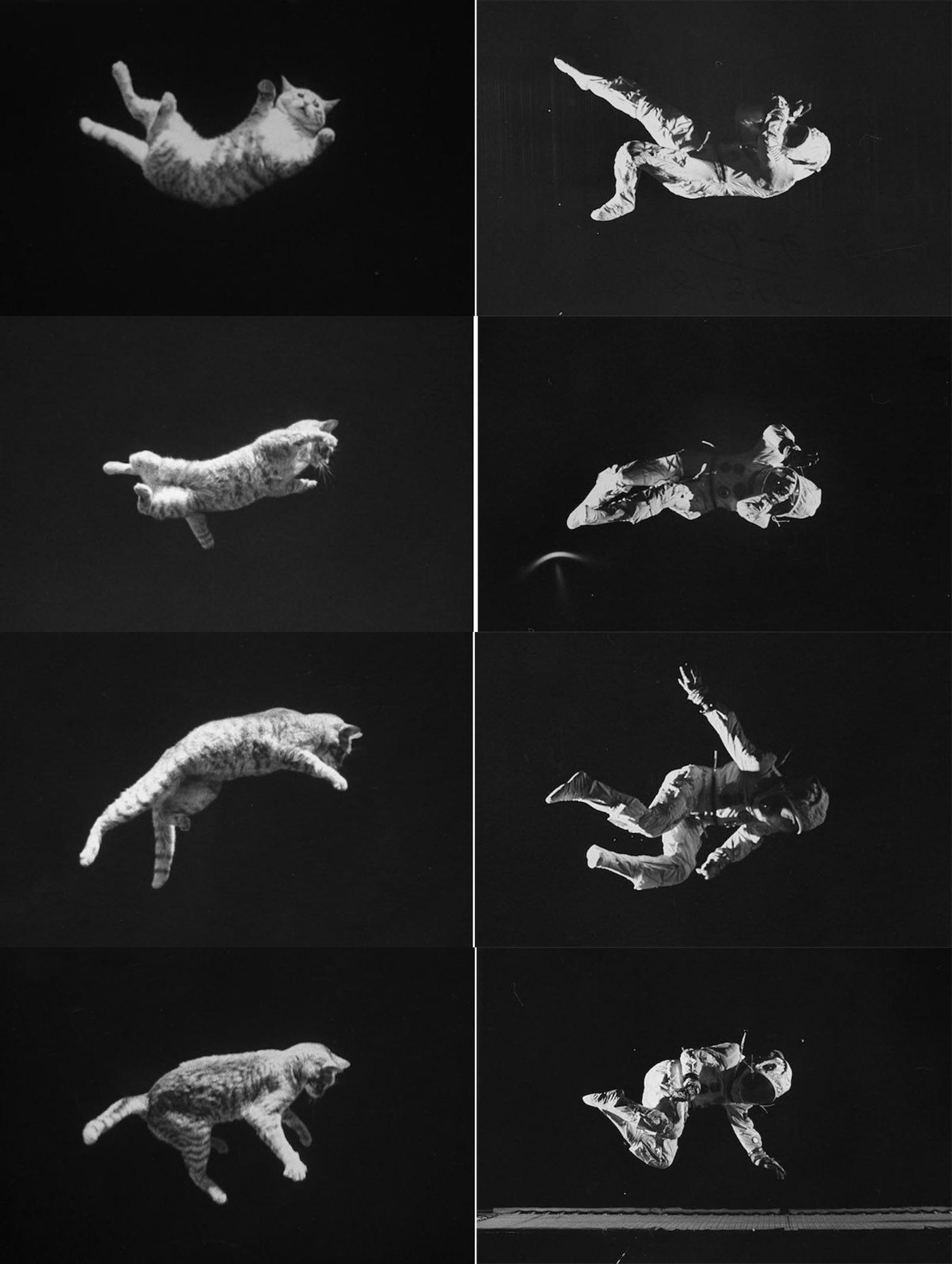

Link to the study in question.
The one with the overlaid diagrams is delightful
Aren’t cats able to do that (always land on their feet) because there’s something inherently unique about their spines? Surely that’s gotta be hard for a human to replicate?
A collarbone that isn’t attached to any other bones and a very flexible spine. However, while this makes them extremely good at it, the actual motions involved are, as demonstrated, manageable for a human. We’re just a lot worse at it
I suspect the specific biomechanics of it change, but the general principle helps to get a starting point for figuring out human-applicable techniques. It was a very cutting-edge field at the time, after all; any advantage or pre-existing applicable work was welcome!
This would be a sick album cover
So they are now breeding astronauts with hyper-flexible spines and much, much faster reflexes?
You should read Firefall, by Peter Watts.
In which they do do that, in a way that is simultaneously the most absurd you’ve ever read, and the most hard sci-fi credible. Mostly so they can hibernate iirc.
You can kind of try reorienting yourself in mid air by just using climbing gear. Have someone else hang you up on a rope (eg when falling off a wall in a climbing gym). Once you’re in mid-air, you can try to make yourself spin (change your yaw) in mid air, the rope won’t help you with that.
If you manage, you won’t look elegant doing it.
It’s quite simple. You point your forelegs towards the ground, and then you point your hind legs toward the ground.