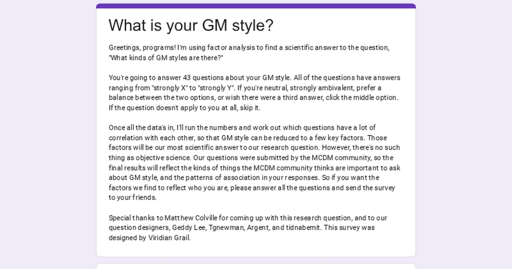
Greetings, programs! I'm using factor analysis to find a scientific answer to the question, "What kinds of GM styles are there?"
You're going to answer 43 questions about your GM style. All of the questions have answers ranging from "strongly X" to "strongly Y". If you're neutral, strongly ambivalent, prefer a balance between the two options, or wish there were a third answer, click the middle option. If the question doesn't apply to you at all, skip it.
Once all the data's in, I'll run the numbers and work out which questions have a lot of correlation with each other, so that GM style can be reduced to a few key factors. Those factors will be our most scientific answer to our research question. However, there's no such thing as objective science. Our questions were submitted by the MCDM community, so the final results will reflect the kinds of things the MCDM community thinks are important to ask about GM style, and the patterns of association in your responses. So if you want the factors we find to reflect who you are, please answer all the questions and send the survey to your friends.
Special thanks to Matthew Colville for coming up with this research question, and to our question designers, Geddy Lee, Tgnewman, Argent, and tidnabemit. This survey was designed by Viridian Grail.
Greetings, programs! With the MCDM community’s help, I’ve prepared a survey of GM styles, so that I can use factor analysis to find the common variables underlying GMs’ responses, and come up with a scientific answer to “what kinds of GM styles are there?” The survey has 43 questions and takes a few minutes to complete. The more people answer, the better the data we’ll get.
EDIT: 52 responses! This is great, keep em coming!
Fun initiative. A bit narrow in its scope as others said because it focuses on DnD style games and fails to encompass much of the rest. Notions like encounter and art prep make no sense if these things are not part of the game. Same with “behind the screen” if there’s no screen, but especially annoying to put sandbox and railroad with no definition on a single scale. Feels like a questionnaire asking about whether you’re catholic or protestant, ignoring the rest of the world’s perspectives.
A fair criticism, as these questions were submitted by the MCDM community, and most of us play Draw Steel, so the questions are probably biased towards games like Draw Steel.
However, if a GM mostly runs Blades in the Dark as a player-directed experience, and spends way more time collecting music and paintings to set the scene and mood, rather than preparing heist obstacles for their Crew, I’d say that GM runs an art-prep-heavy sandbox game. Such a GM might also prefer to hide enemy factions’ plans from the players and blindside them with twists, or roll on the complication table in front of the players and let them see how the mechanics are creating the story. So while I agree with your point, I don’t actually find your examples convincing. Perhaps you have experience with games even less like D&D than BitD, and I’m simply too narrow minded to understand your critiques.
Using that game would then make less sense to ask about encounters or challenging players/characters, or railroaing, or sandboxing.
Same for example if a game has a specifically defined setting not made by gm or players, does not have encounters and is not involve the idea of challenging anyone. Technically, I can go around the world classifying people as “proactive” or “reactive” in the way they see life, but it would not necessarily mean much to many of them.
But it is fine, I’m far from being representative. Many questions work on a broader scale, but some did not. Especially if my perspective on ttrpgs does not align with the way things are often presented in groups where DnD is a synonym for ttrpgs.


Fun initiative. A bit narrow in its scope as others said because it focuses on DnD style games and fails to encompass much of the rest. Notions like encounter and art prep make no sense if these things are not part of the game. Same with “behind the screen” if there’s no screen, but especially annoying to put sandbox and railroad with no definition on a single scale. Feels like a questionnaire asking about whether you’re catholic or protestant, ignoring the rest of the world’s perspectives.
A fair criticism, as these questions were submitted by the MCDM community, and most of us play Draw Steel, so the questions are probably biased towards games like Draw Steel.
However, if a GM mostly runs Blades in the Dark as a player-directed experience, and spends way more time collecting music and paintings to set the scene and mood, rather than preparing heist obstacles for their Crew, I’d say that GM runs an art-prep-heavy sandbox game. Such a GM might also prefer to hide enemy factions’ plans from the players and blindside them with twists, or roll on the complication table in front of the players and let them see how the mechanics are creating the story. So while I agree with your point, I don’t actually find your examples convincing. Perhaps you have experience with games even less like D&D than BitD, and I’m simply too narrow minded to understand your critiques.
Nah, you’re probably right that I was not very good at explaining myself.
I think this one link can hopefully make my point clearer: 1d6chan.miraheze.org/wiki/Everyone_Is_John
Using that game would then make less sense to ask about encounters or challenging players/characters, or railroaing, or sandboxing.
Same for example if a game has a specifically defined setting not made by gm or players, does not have encounters and is not involve the idea of challenging anyone. Technically, I can go around the world classifying people as “proactive” or “reactive” in the way they see life, but it would not necessarily mean much to many of them.
But it is fine, I’m far from being representative. Many questions work on a broader scale, but some did not. Especially if my perspective on ttrpgs does not align with the way things are often presented in groups where DnD is a synonym for ttrpgs.
Wowee, that game looks like fun! I’ll go play it with My friends now!