I tend to find an 2:1 or 3:1 combat/non-combat gives people a good mix of the action/adventure elements and the high drama. Combat just tends to take longer than drama, so even when you try to minimize it, you can often find yourself in a time-suck.
I also tend to feel that any “withering encounter” should resolve as soon as the players are more-or-less assured of victory (like, 2-3 turns, unless things go disastrously wrong for the players). Big center-piece boss battles can take longer, but need some kind of high drama element (exploding volcano, NPC dangling off a cliff, evil wizard powering up a death ray, etc) that (a) gives players a puzzle or drama point to resolve and (b) gives someone an opportunity to do something passionate or wacky (swinging in on a chandelier, flinging themselves on a hand grenade, asking their beau to marry them in the middle of a sword fight).
Any encounter that’s just “roll the dice, pass the turn” is a waste of everyone’s time, IMHO.
Every player is different, every DM is different. Thats why communication at the top is important, if you want to get heavily in to character and roleplay a detective mystery in the tavern, let your DM know that.

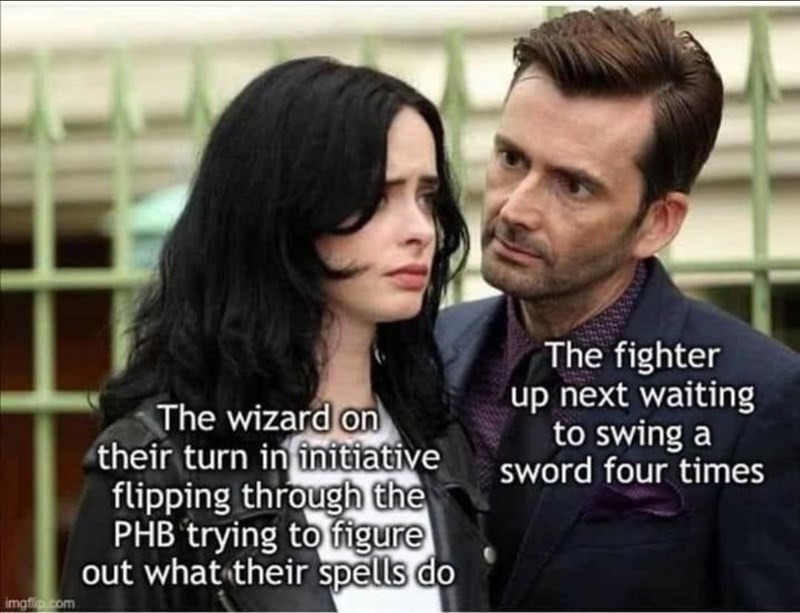
this is why ttrpgs should not be so combat-focused.
Depends on the players. Some want to play pretend. Some want to play XCOM with dice.
themoken@startrek.website Some want to play XCOM without dice, and get really pissy when the dice say “no”.
I tend to find an 2:1 or 3:1 combat/non-combat gives people a good mix of the action/adventure elements and the high drama. Combat just tends to take longer than drama, so even when you try to minimize it, you can often find yourself in a time-suck.
I also tend to feel that any “withering encounter” should resolve as soon as the players are more-or-less assured of victory (like, 2-3 turns, unless things go disastrously wrong for the players). Big center-piece boss battles can take longer, but need some kind of high drama element (exploding volcano, NPC dangling off a cliff, evil wizard powering up a death ray, etc) that (a) gives players a puzzle or drama point to resolve and (b) gives someone an opportunity to do something passionate or wacky (swinging in on a chandelier, flinging themselves on a hand grenade, asking their beau to marry them in the middle of a sword fight).
Any encounter that’s just “roll the dice, pass the turn” is a waste of everyone’s time, IMHO.
Every player is different, every DM is different. Thats why communication at the top is important, if you want to get heavily in to character and roleplay a detective mystery in the tavern, let your DM know that.